6.1 Automated and emerging technologies
Automated Systems
How Automated Systems Work
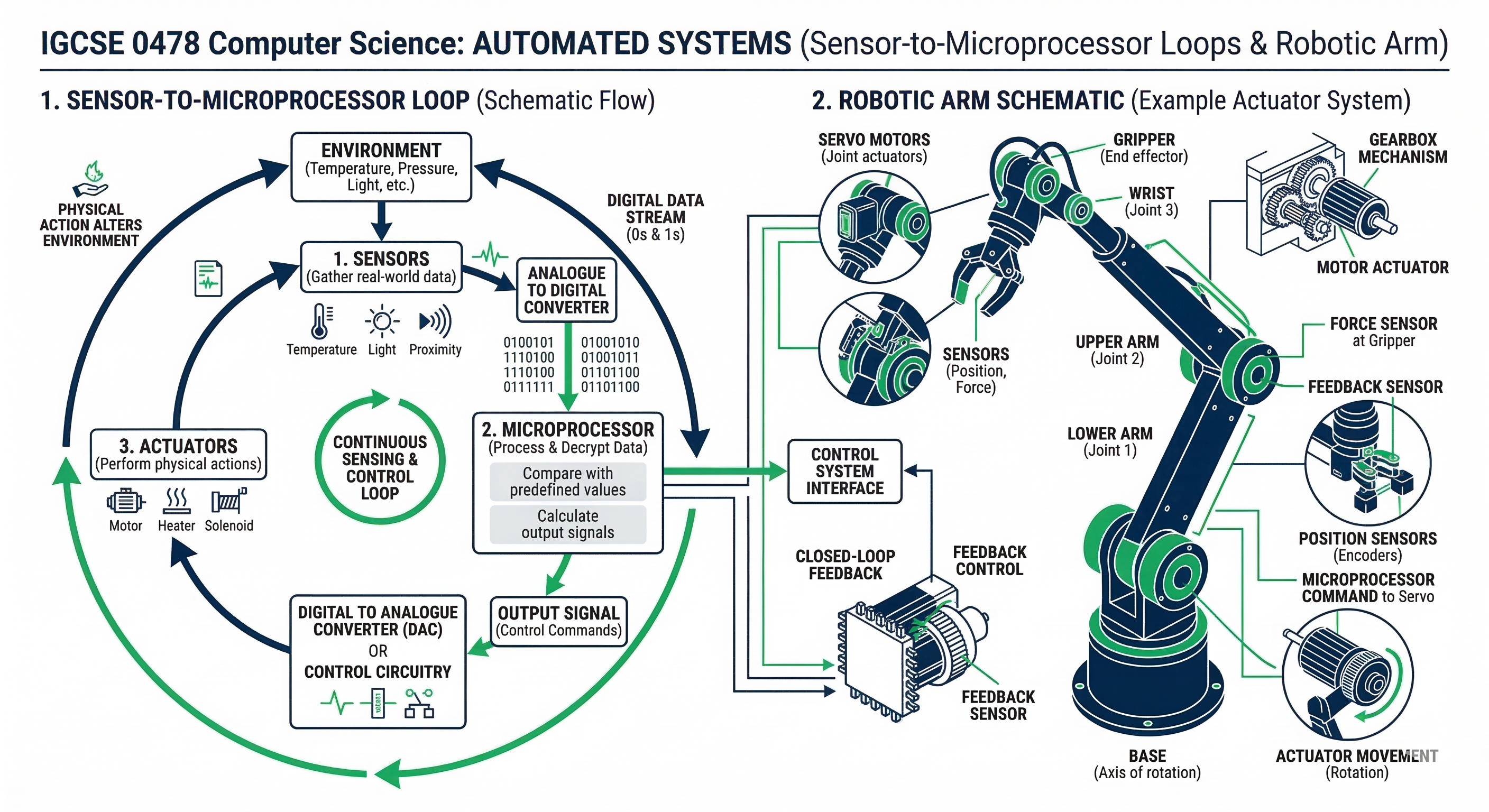
An automated system consists of Sensors, a Microprocessor, and Actuators. It functions in a continuous loop without human intervention.
The Control Loop:
- Sensors collect physical data (e.g., temperature).
- Data is converted from Analogue to Digital (ADC).
- The Microprocessor compares the data to pre-set values.
- If values are outside the range, the Microprocessor sends a signal to an Actuator (e.g., turn on a heater).
Robotics
What makes a Robot?
A robot is a programmable machine capable of carrying out a complex series of actions automatically. It must have:
- A Mechanical Structure: The physical frame or body.
- Electrical Components: Sensors and power sources.
- Programming: To determine how it responds to its environment.
Exam Advantage: Robots can work in dangerous environments (e.g., deep sea) and perform repetitive tasks with 100% consistency.
Artificial Intelligence
Expert Systems and AI
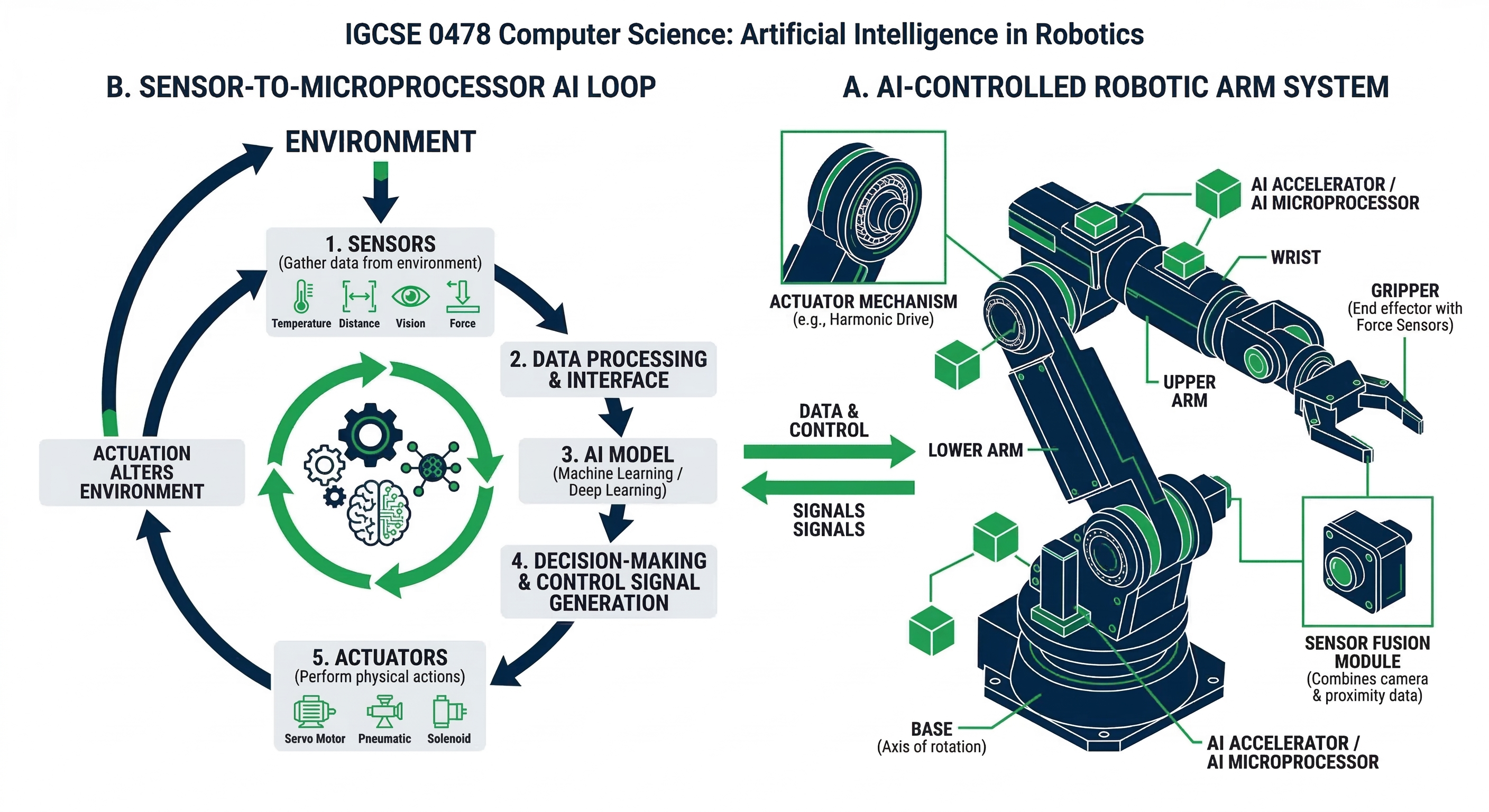
AI is the simulation of human intelligence by machines. A common form in the syllabus is the Expert System.
Components of an Expert System:
- Knowledge Base: A repository of facts and rules.
- Inference Engine: The "brain" that applies rules to the facts to make decisions.
- User Interface: Where the user asks questions (e.g., a medical diagnosis app).
Machine Learning
Learning from Data
Machine Learning is a sub-set of AI. Instead of following fixed rules, the system uses algorithms to find patterns in data and improve its performance over time.
Key Difference: Traditional AI follows "If-Then" rules. Machine Learning "learns" from examples without being explicitly programmed for every scenario.