8.1 Programming
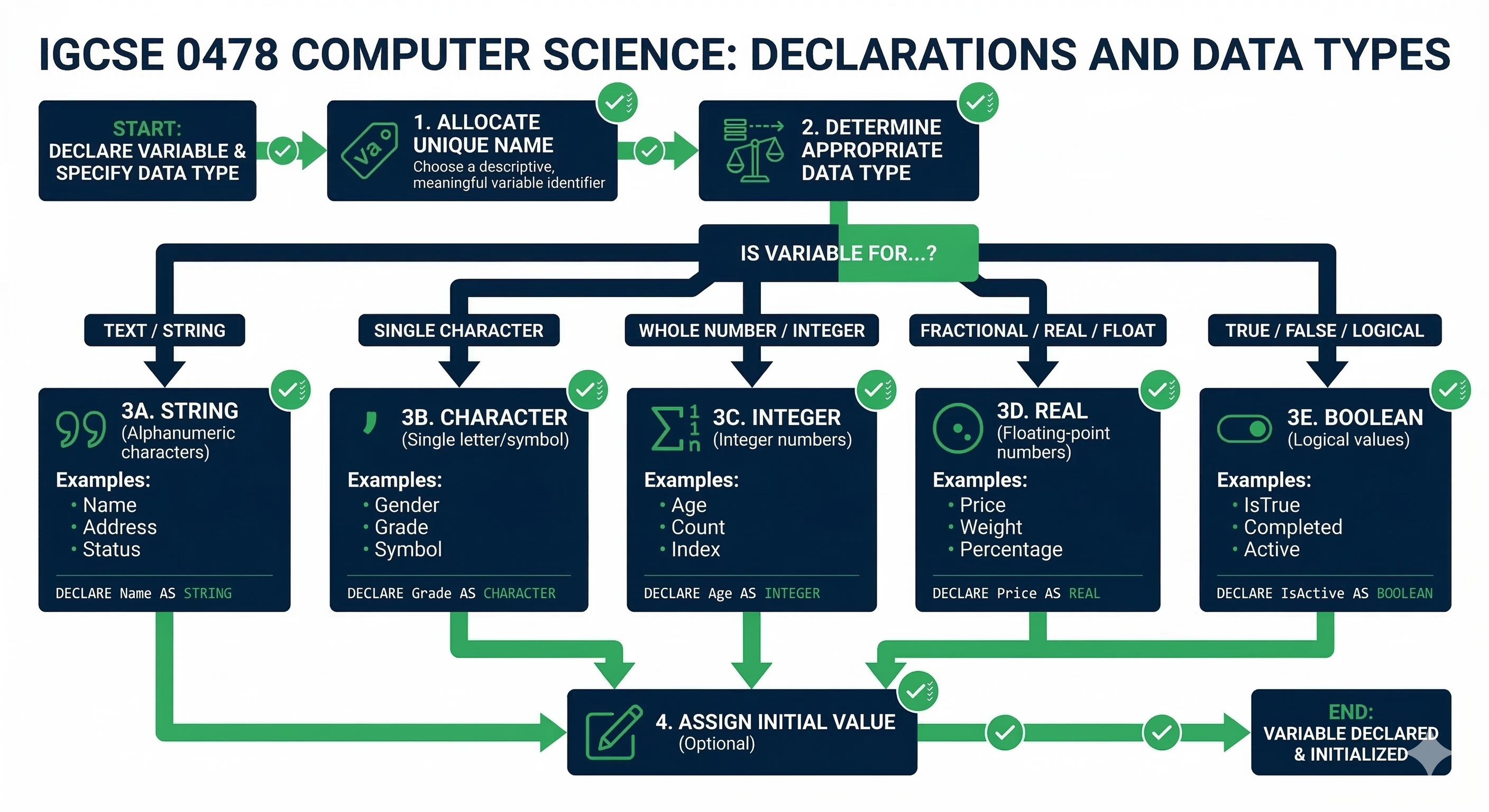
Declarations and Data Types
Storing Data
Programs need to store data in memory locations. We categorize these into two types:
- Variables: The value can change during the program execution (e.g., a Score).
- Constants: The value remains fixed throughout (e.g., PI = 3.142).
IGCSE Data Types:
- INTEGER: Whole numbers (e.g., 10, -5).
- REAL: Numbers with decimals (e.g., 15.5).
- CHAR: A single character (e.g., "A").
- STRING: Multiple characters (e.g., "Hello").
- BOOLEAN: TRUE or FALSE.
Basic Constructs
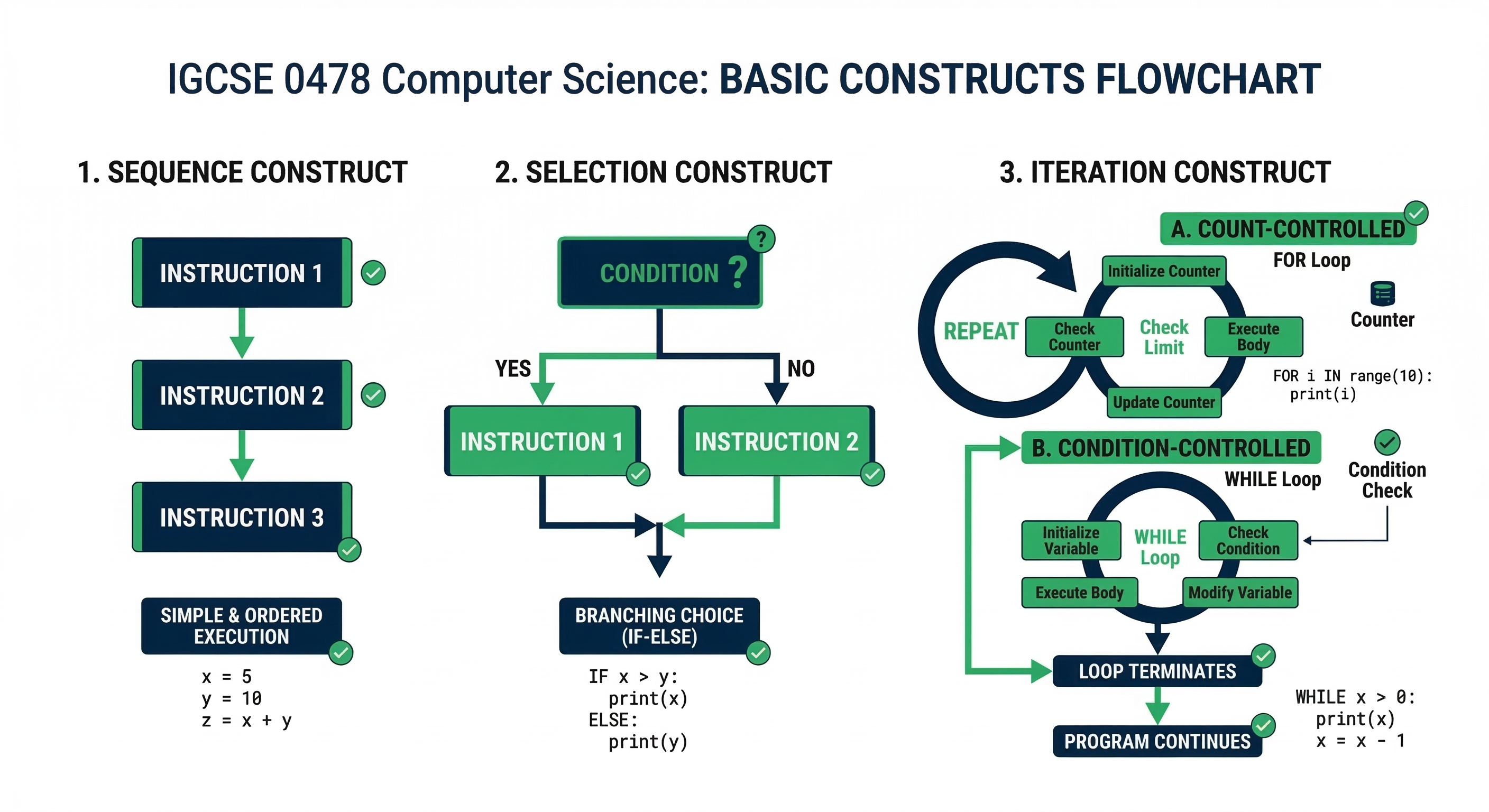
Sequence and Selection
All programs are built using three main structures. The first two are:
- Sequence: Statements are executed one after another in order.
- Selection: The program takes different paths based on a condition (e.g.,
IF...THEN...ELSEorCASE).
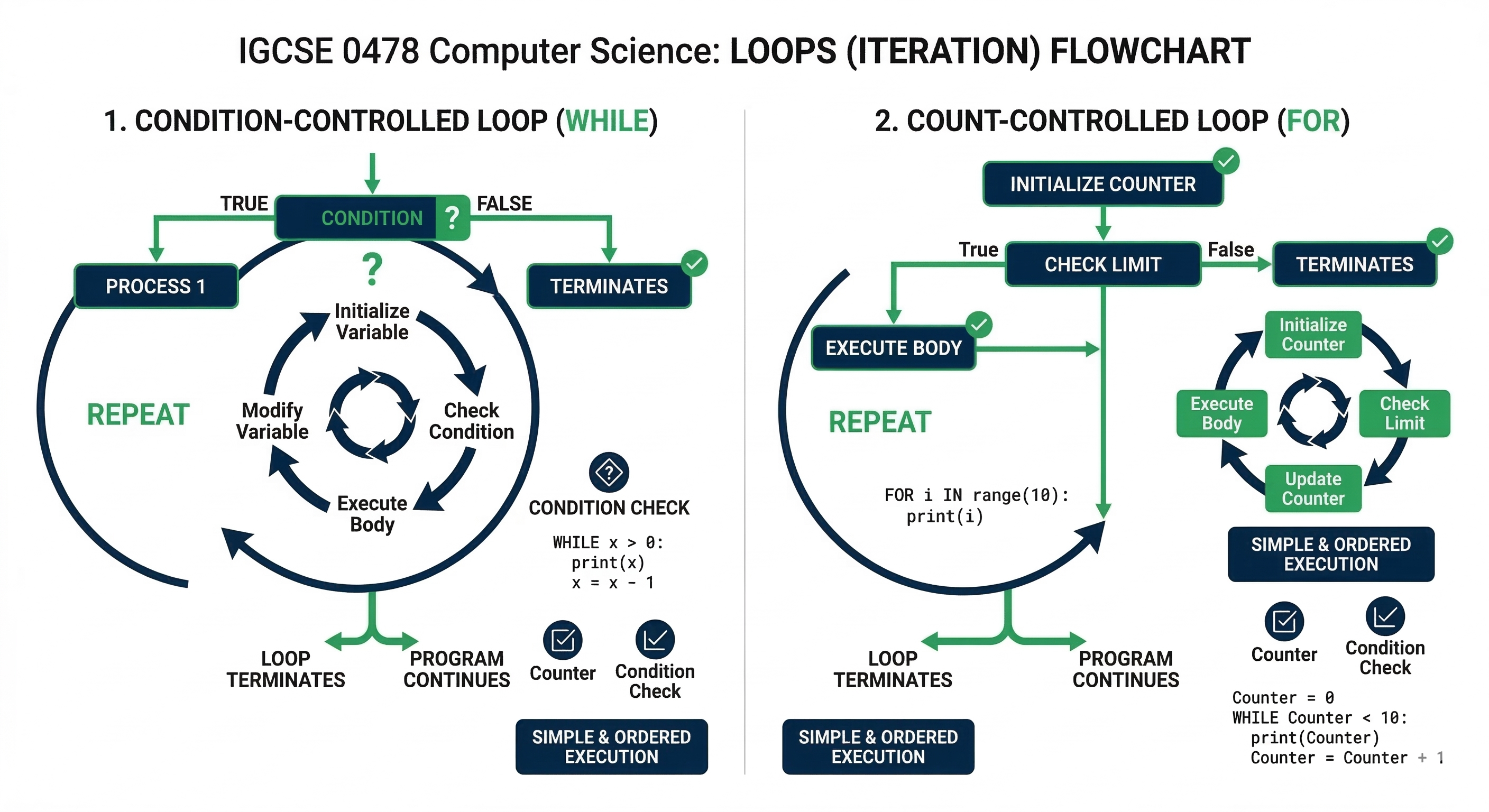
Loops (Iteration)
Repeating Code
Cambridge focuses on three types of loops in pseudocode:
- FOR...TO...NEXT: Count-controlled (runs a set number of times).
- WHILE...DO...ENDWHILE: Pre-condition (checks the condition before running).
- REPEAT...UNTIL: Post-condition (runs at least once, checks after).
Examiner Insight: Ensure loops terminate correctly! Avoid "Infinite Loops" by updating your counter or condition variable.