2.1 Data Transmission
Methods of Transmission
Serial vs Parallel Transmission
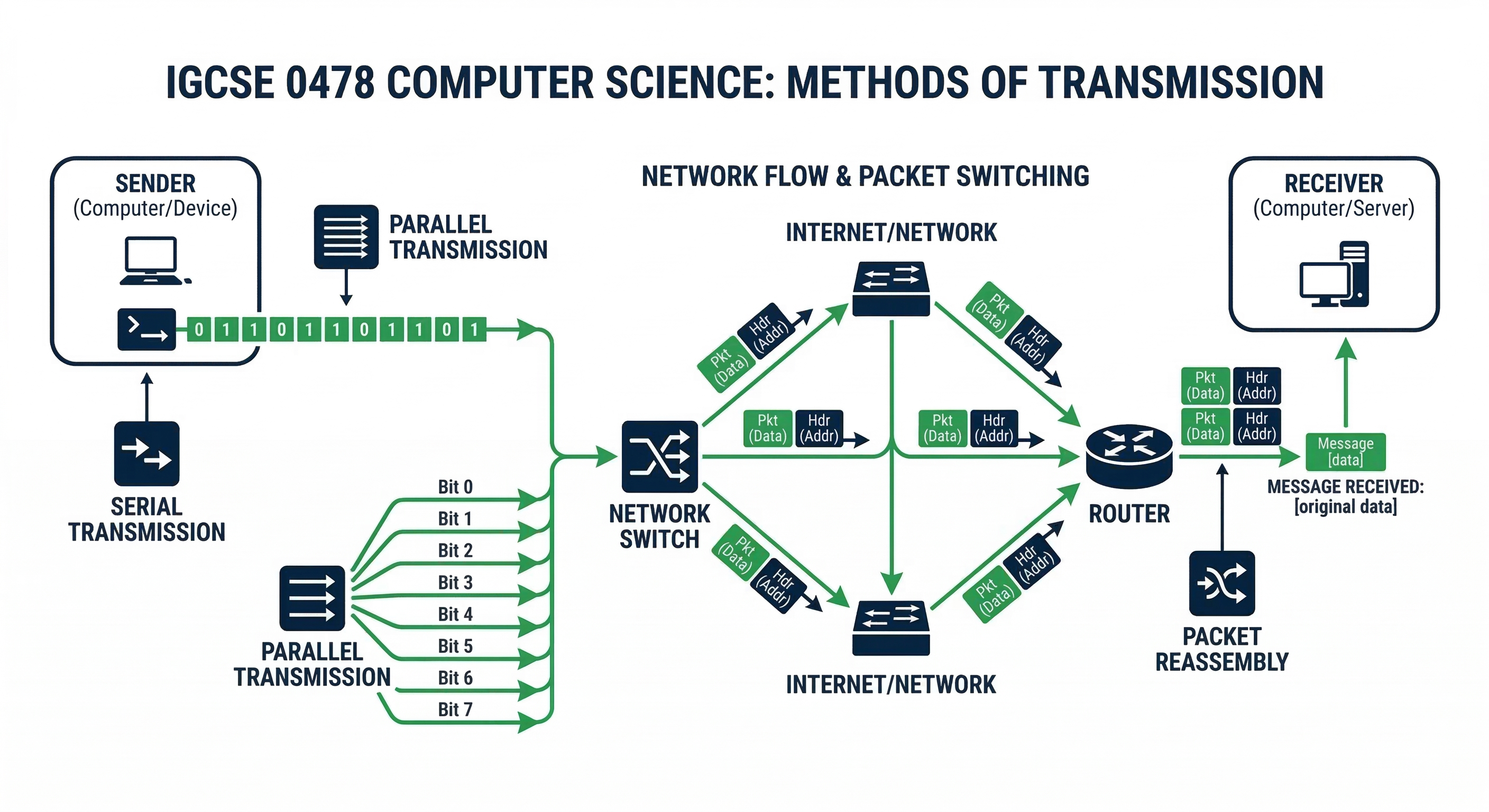
Data is transmitted in two primary ways depending on how many wires are used:
- Serial: Data is sent one bit at a time over a single wire. It is reliable over long distances and cheaper to implement.
- Parallel: Multiple bits are sent simultaneously over multiple wires. It is faster but limited to very short distances (e.g., inside a computer) due to skewing.
Key Term: Skewing - This occurs in parallel transmission when bits arrive at slightly different times, causing data corruption.
Methods of Transmission
Serial vs Parallel Transmission
Data is transmitted in two primary ways depending on how many wires are used:
- Serial: Data is sent one bit at a time over a single wire. It is reliable over long distances and cheaper to implement.
- Parallel: Multiple bits are sent simultaneously over multiple wires. It is faster but limited to very short distances (e.g., inside a computer) due to skewing.
Key Term: Skewing - This occurs in parallel transmission when bits arrive at slightly different times, causing data corruption.
Transmission Directions
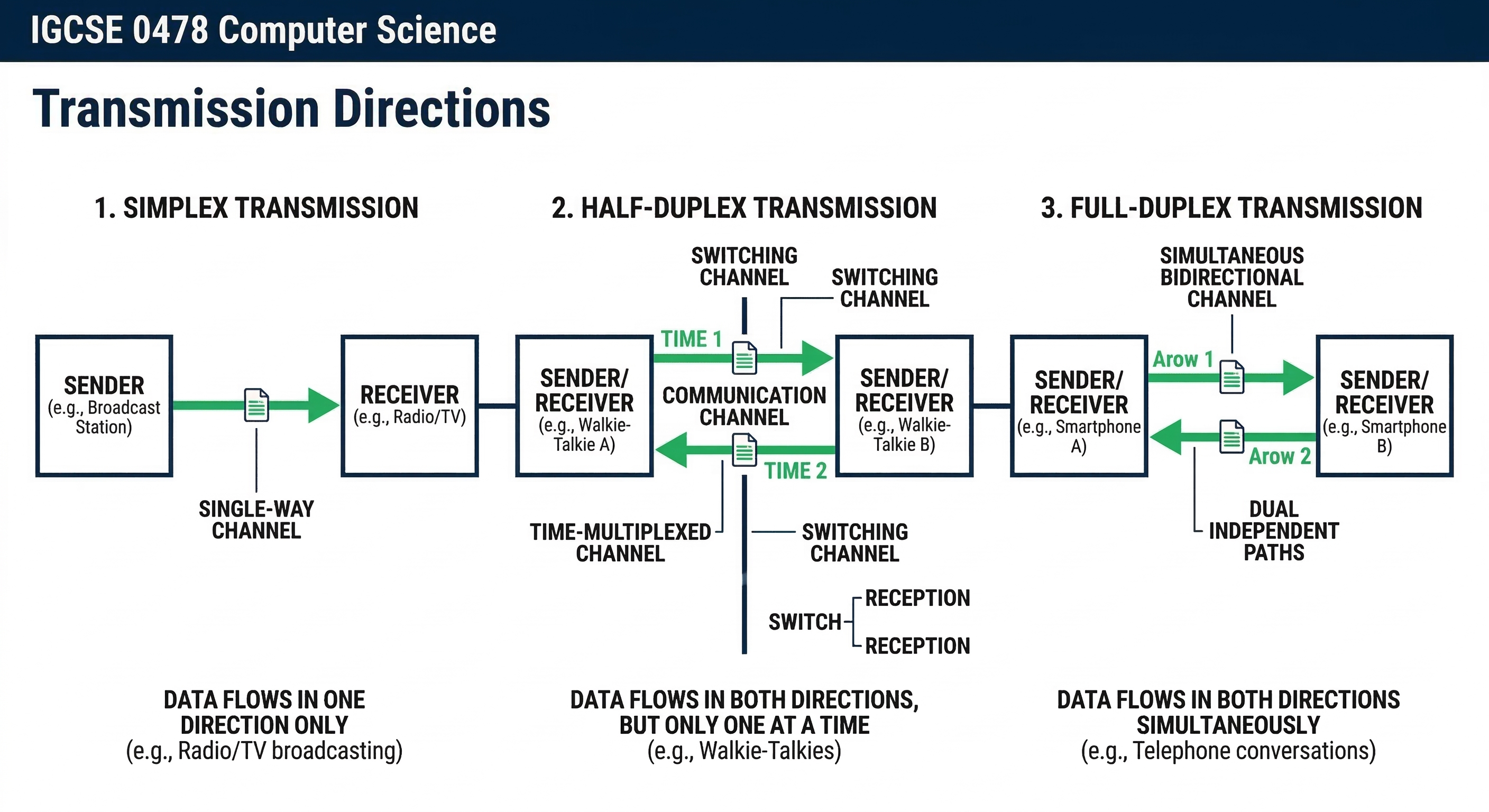
Simplex, Half-Duplex, and Full-Duplex
- Simplex: Data travels in one direction only (e.g., a microphone to a computer).
- Half-Duplex: Data travels in both directions, but not at the same time (e.g., a walkie-talkie).
- Full-Duplex: Data travels in both directions simultaneously (e.g., a telephone call or broadband internet).
Transmission Directions
Simplex, Half-Duplex, and Full-Duplex
- Simplex: Data travels in one direction only (e.g., a microphone to a computer).
- Half-Duplex: Data travels in both directions, but not at the same time (e.g., a walkie-talkie).
- Full-Duplex: Data travels in both directions simultaneously (e.g., a telephone call or broadband internet).
Packet Switching
How Data Travels (Packets)
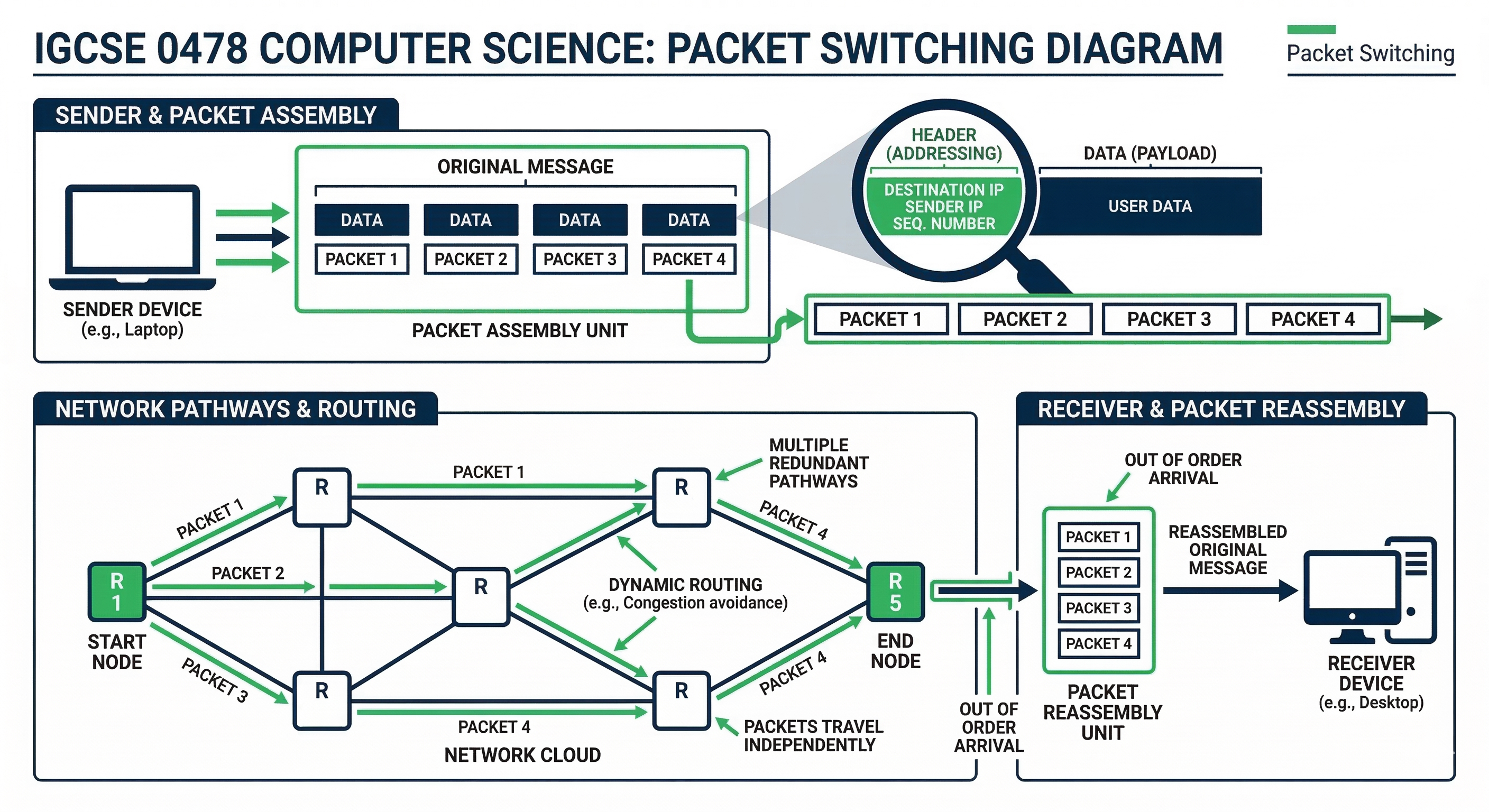
Large files are broken down into smaller units called Packets. Each packet contains:
- Header: Destination IP address, Packet number, and Sender IP.
- Payload: The actual data.
- Trailer: Error-checking data (like a Checksum).
Packets are sent independently across the internet via Routers and reassembled at the destination.
Packet Switching
How Data Travels (Packets)
Large files are broken down into smaller units called Packets. Each packet contains:
- Header: Destination IP address, Packet number, and Sender IP.
- Payload: The actual data.
- Trailer: Error-checking data (like a Checksum).
Packets are sent independently across the internet via Routers and reassembled at the destination.